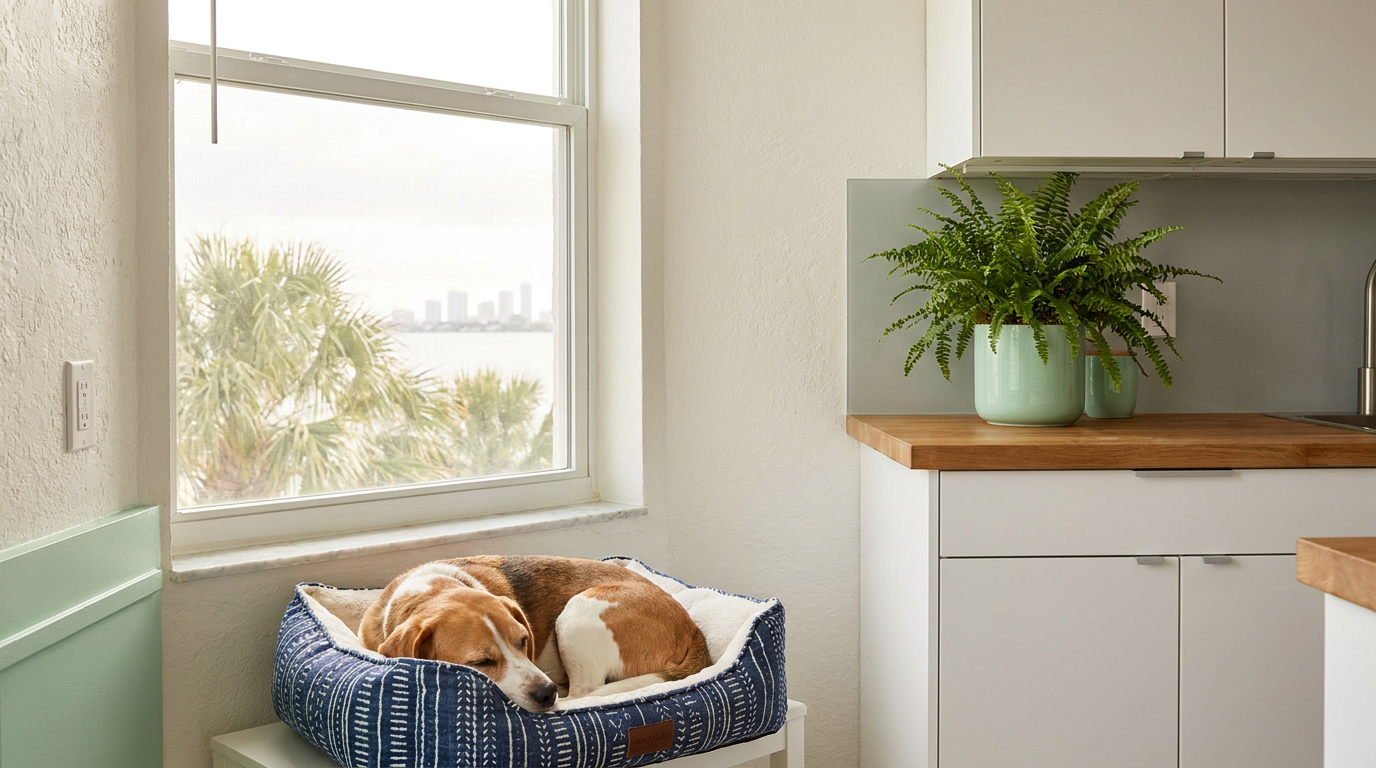
Social Anxiety and ESA Letters in Florida: When the Home Feels Like the Safe Place
Disclaimer: This article is for informational purposes only. It is not medical, mental-health, or legal advice. Consult a Florida-licensed mental health professional to determine whether an ESA letter is appropriate for your situation. For housing disputes, consult a Florida-licensed attorney or your local legal aid office.
For millions of people, home isn't just a preference, it's a lifeline. If social anxiety or agoraphobia makes leaving the house feel overwhelming, your living space becomes more than four walls. It becomes the place where you can finally breathe. When that space feels threatened, by a no-pets policy, a landlord demanding documentation, or an unexpected lease clause, the stress can spiral fast.
Here's the good news: under federal fair housing law, an Emotional Support Animal (ESA) may qualify as a reasonable accommodation in your housing situation. And in Florida, there's a clear, straightforward path to getting a legitimate ESA letter from a licensed clinician. This guide walks you through every step.
What You Need Before You Start (Your "Materials" Checklist)
Think of this like a recipe. Before you begin, gather the following:
- A Florida-licensed mental health professional (LMHP). This is non-negotiable under Florida law. FL Statute 760.27 requires that the clinician issuing your ESA letter be licensed in the state of Florida, or have an established prior in-person relationship with you. Out-of-state online providers cannot issue a legally valid Florida ESA letter. Full stop.
- Honest information about your mental health history. You don't need a formal diagnosis written on a sticky note. You need to be prepared to discuss your symptoms, how they affect your daily life, and how an animal may help. The clinician will guide the conversation.
- Your housing situation details. Know whether you rent or own, whether your building has a no-pets policy, and whether you've already received a denial or request for documentation from your landlord.
- Your animal (or a plan for one). Your ESA doesn't need to be specially trained. Any domesticated animal may qualify, dog, cat, rabbit, and others, as long as a licensed clinician determines it is therapeutically appropriate for you.
- Time and realistic expectations. A legitimate ESA letter requires a real clinical evaluation. Turnaround is typically fast with a telehealth provider, but it is never "instant" or "guaranteed." Any service promising that is a red flag.
Step-by-Step: How to Get an ESA Letter for Social Anxiety or Agoraphobia in Florida
Step 1: Understand What an ESA Letter Actually Is
An ESA letter is a formal document written on official letterhead by a Florida-licensed mental health professional. It states that you have a mental or emotional condition that qualifies as a disability under the Fair Housing Act, and that your emotional support animal provides therapeutic benefit related to that condition.
It is not a certificate, a registry entry, or an ID card. HUD has explicitly confirmed that online "ESA registries" and "certified ESA" badges have no legal standing. If a website is selling you a certificate for $29.99 without a clinical evaluation, you're buying a piece of paper that your landlord can, and likely will, reject.
The legal authority for ESA housing rights is HUD's FHEO-2020-01 notice, "Assessing a Person's Request to Have an Animal as a Reasonable Accommodation Under the Fair Housing Act." That's your federal foundation.
Step 2: Confirm You May Qualify
Social anxiety disorder and agoraphobia are among the mental health conditions that many people find are well-supported by an emotional support animal. A clinician will assess whether your condition rises to the level of a disability under the FHA, meaning it substantially limits one or more major life activities.
You don't need to self-diagnose. That's the clinician's job. But ask yourself honestly: Do your anxiety symptoms significantly affect your ability to leave the house, interact with neighbors, or function in your daily living environment? If the answer feels like a hard yes, it may be worth exploring further.
For a deeper look at how anxiety conditions are evaluated, see our guide on anxiety ESA eligibility in Florida. If panic disorder is part of your picture, our panic disorder ESA eligibility guide covers the specifics.
Step 3: Choose a Florida-Licensed Provider, and Verify It
This step is where most people make expensive mistakes. Here's what to look for:
- The clinician must hold an active Florida license. Acceptable license types include Licensed Clinical Social Worker (LCSW), Licensed Mental Health Counselor (LMHC), Licensed Marriage and Family Therapist (LMFT), psychologist, or psychiatrist.
- You can verify any Florida clinician's license at the Florida Department of Health MQA portal (flhealthsource.gov). Take two minutes and check.
- Telehealth is fine, Florida allows licensed clinicians to conduct evaluations via video or phone. But the clinician must be licensed in Florida to issue a valid letter under FL Statute 760.27.
- Avoid any service that skips a real evaluation, promises "guaranteed approval," or doesn't let you speak with or message an actual clinician.
At Cheap ESA Letter Florida, every evaluation is conducted by a Florida-licensed mental health professional. Our pricing is straightforward, and we don't charge you if a clinician determines an ESA letter isn't appropriate for your situation.
Step 4: Complete Your Clinical Evaluation
The evaluation is a real conversation, not a checkbox form. Expect to discuss:
- Your current symptoms and how long you've been experiencing them
- How social anxiety or agoraphobia affects your daily life, especially at home
- Whether you're currently in treatment, on medication, or managing symptoms independently
- What animal you have or are considering, and why you believe it helps
Be honest. Clinicians are trained to have these conversations without judgment. The goal isn't to catch you out, it's to determine whether an ESA is genuinely therapeutically appropriate for you.
Most telehealth evaluations take 20–45 minutes. If approved, your letter is typically delivered digitally within 24–48 hours, though turnaround times can vary.
Step 5: Review Your Letter Before Sending It to Your Landlord
A valid Florida ESA letter should include:
- The clinician's full name, license type, and Florida license number
- The clinician's contact information (so the landlord can verify)
- A statement that you have a disability as defined under the FHA
- A statement that your ESA provides therapeutic benefit related to that disability
- The date of issue (letters are typically valid for one year)
- The clinician's original signature
It does not need to name your specific diagnosis. In fact, federal guidance confirms your landlord is not entitled to your full medical history, only sufficient information to evaluate the accommodation request.
Step 6: Submit Your Request to Your Landlord or Housing Provider
Under the Fair Housing Act, most housing providers, including those with no-pets policies, must consider reasonable accommodation requests for assistance animals. This applies to most private landlords, apartment complexes, HOAs, and condo associations. (Certain owner-occupied buildings with four or fewer units may be exempt.)
Submit your ESA letter in writing. Email with a read receipt is ideal, it creates a paper trail. Keep copies of everything.
Your landlord may request additional verification from your clinician directly. That's allowed under HUD guidance. What they cannot do is charge you a pet fee, demand breed or weight exceptions be waived, or deny your request without engaging in an interactive process.
For a full breakdown of your rights and the submission process, read our Florida ESA housing letter and FHA guide.
Step 7: Know What to Do If You're Denied
If your landlord denies a valid ESA accommodation request, you have options:
- File a complaint with HUD at hud.gov/program_offices/fair_housing, there is no filing fee.
- File a complaint with the Florida Commission on Human Relations (FCHR) under the Florida Fair Housing Act.
- Consult a Florida-licensed attorney who handles fair housing cases. Many offer free initial consultations, and some work on contingency for FHA violations.
- Contact your local legal aid office, Florida Legal Services (floridalegal.org) can help if cost is a concern.
Do not just accept a denial and move on. Unlawful denial of a reasonable accommodation is a serious FHA violation.
Common Mistakes to Avoid
- Buying from an out-of-state telehealth mill. If the website doesn't clearly state that the clinician is Florida-licensed, walk away. FL Statute 760.27 is specific.
- Confusing an ESA letter with pet registration. There is no national ESA registry. If a site is selling you a registration certificate or ID card, that's a scam, and your landlord will know it.
- Assuming your ESA covers air travel. It does not. The DOT removed ESAs from Air Carrier Access Act protections in 2021. Airlines treat ESAs as regular pets. If you need in-cabin travel accommodations for a psychiatric condition, ask a clinician about a Psychiatric Service Dog (PSD), a different and more rigorous designation.
- Waiting until you're in a housing crisis. Get your letter before you need it urgently. A rushed process can mean cutting corners, and a landlord dispute is not the time to discover your letter has a problem.
- Not keeping records. Save every email, every letter, every response. If you ever need to file a complaint, documentation is everything.
What to Realistically Expect
If a Florida-licensed clinician determines that an ESA letter is appropriate for your situation, many people with social anxiety and agoraphobia find that having a documented emotional support animal in their home provides meaningful comfort and stability. That's the therapeutic goal, not a legal loophole, but a genuine clinical tool.
Housing outcomes vary. Most landlords who receive a properly documented ESA request from a licensed clinician do grant the accommodation. But results depend on your specific housing situation, your landlord's responsiveness, and the quality of your documentation. No one can guarantee a specific outcome, and anyone who does is not being honest with you.
Ready to Take the Next Step?
If you're living with social anxiety or agoraphobia in Florida, and your home is the place where you feel safest, you deserve to protect that space. A legitimate ESA letter from a Florida-licensed clinician is an affordable, accessible way to do exactly that.
Prices at Cheap ESA Letter Florida are transparent and posted upfront, no surprise fees, no upsells. You speak with a real Florida-licensed clinician. And if the evaluation determines an ESA letter isn't right for you, you won't be charged for a letter you can't use.
Start with our Florida anxiety ESA eligibility guide to understand what to expect from the clinical evaluation, then take it one step at a time.
A note on this content: This article is informational only and does not constitute medical, mental-health, or legal advice. Every person's situation is different. Please consult a Florida-licensed mental health professional to determine whether an ESA letter is clinically appropriate for you. For any landlord dispute or fair housing concern, consult a Florida-licensed attorney or contact your local legal aid organization.
Ready to start your Florida ESA letter?
Licensed Florida clinician review. Compliant with state law.
Start My Florida ESA Letter